
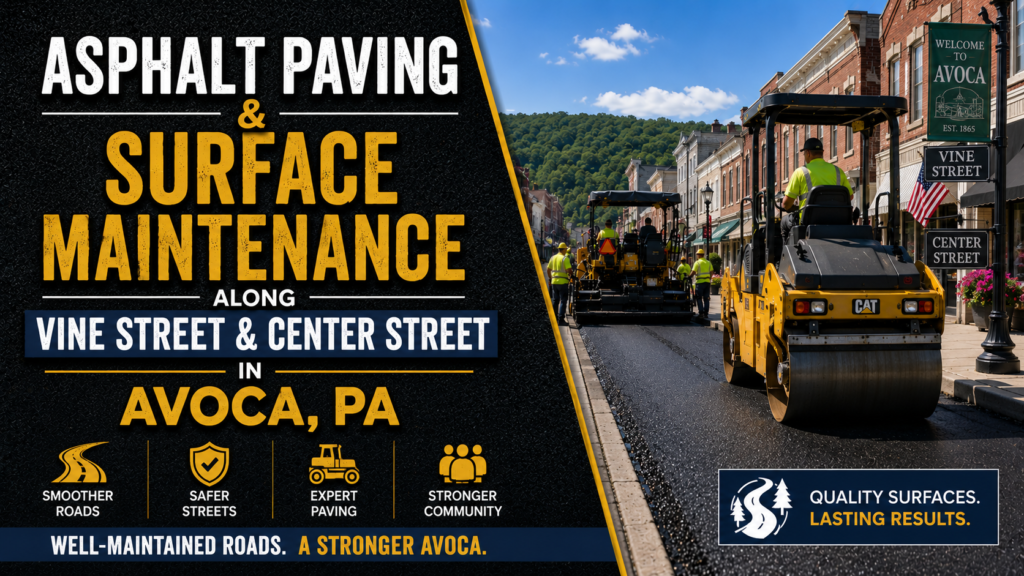
In any small borough, certain streets serve as more than simple transit routes they become connectors, forming the arteries that link residential clusters to community centers, schools, and commercial districts. In Avoca, Pennsylvania, the Asphalt Contractor Vine Street Center Street represents exactly this kind of interconnecting zone. Streets that carry local traffic, front residential properties, and serve the everyday movement of a community that has occupied this patch of Luzerne County for well over a century.
The intersection of residential density and community activity along corridors like these places special demands on pavement infrastructure. Driveways and parking surfaces must serve homeowners and visitors alike. Surfaces endure vehicle traffic from early morning to late evening. And in a borough where many structures date back to the early 20th century, the paving around those structures often needs attention.
This article takes a closer look at asphalt paving in the context of this kind of active residential-commercial corridor exploring how asphalt is specified, installed, and maintained for maximum service life in a community environment.
The Science of Asphalt Mix Design
Not all asphalt is the same. Behind the uniform black surface of every paved road, driveway, or parking lot lies a specific mix design an engineered recipe that determines how that asphalt will perform under real-world conditions.
Asphalt mix design is governed by several key factors:
Aggregate Gradation: The size distribution of aggregate particles profoundly affects mix behavior. Well-graded mixes (containing a range of particle sizes) provide better interlocking and stability. Gap-graded mixes (with certain size fractions absent) are used for specific applications like stone mastic asphalt, which provides excellent rutting resistance.
Binder Grade: The American Association of State Highway and Transportation Officials (AASHTO) has developed a Performance Grading (PG) system for asphalt binders. In Pennsylvania’s climate, binders must perform at both the high end (summer heat) and the low end (winter cold) of the temperature spectrum. The PG grade specified for a project reflects the local climate and anticipated traffic loads.
Air Voids: The target air void content in a compacted mix is typically 4%. Too many voids leads to premature oxidation and water infiltration; too few leads to rutting as the binder has no room to move under load.
Voids in Mineral Aggregate (VMA): This represents the space between aggregate particles in a compacted mix, which is filled by binder and air voids. Adequate VMA is necessary to ensure sufficient binder content for durability.
Asphalt Content: The percentage of binder by weight in the mix affects both durability and performance. Too little binder produces a dry, raveling mix; too much produces a rich, rutting-prone mix.
These design parameters are determined through laboratory testing and are adjusted to meet the specific performance requirements of each project. On a busy residential corridor like Vine Street or Center Street, a mix designed for durability and rutting resistance is appropriate given the frequency of vehicle traffic.
Surface Course vs. Base Course: Understanding the Layers
Many property owners assume that all asphalt is the same that it’s simply a matter of how thick the layer is. In reality, the different layers of an asphalt pavement system serve distinct functions and are composed of different mix types:
Base Course (Also Called Binder Course): This is the structural layer the workhorse of the pavement system. It is composed of coarser aggregate (typically 3/4″ to 1″ maximum size) bound with a higher-penetration asphalt binder. The base course distributes traffic loads over the subbase and is designed for structural strength rather than surface smoothness. Typical thickness in residential applications: 2–3 inches.
Surface Course (Also Called Wearing Course): This is the top layer that drivers, pedestrians, and property owners interact with directly. It is composed of finer aggregate (typically 3/8″ to 1/2″ maximum size) and a stiffer binder grade. It provides a smooth, skid-resistant surface, weatherproofs the layers below, and gives the pavement its visual character. Typical thickness: 1–1.5 inches.
Tack Coat: Between the base course and the surface course, contractors apply a thin emulsified asphalt tack coat. This creates a bonding layer that ensures the two courses adhere to each other and perform as a unified system. Skipping the tack coat can lead to delamination the surface peeling away from the base as a distinct slab.
In high-traffic areas or commercial applications, a third layer the intermediate binder course may be used between base and surface to add structural depth.
Understanding Pavement Markings and Their Role in Safety
In any street-facing or community-oriented paving project, pavement markings play a crucial but often overlooked role. Line striping on parking areas and driveways does more than just look neat it:
Defines Traffic Flow: Arrows, lane lines, and entry/exit markings guide drivers through parking areas efficiently, reducing the confusion and risk of collisions that come with unorganized lots.
Maximizes Space Utilization: Properly spaced parking stall markings allow the maximum number of vehicles to use a lot safely, which matters in dense neighborhood settings where parking is at a premium.
Establishes Safety Zones: Crosswalk markings, no-parking zones, fire lane designations, and pedestrian pathways protect people on foot in mixed vehicle-pedestrian environments.
Supports ADA Compliance: Handicapped accessible parking stalls, access aisles, and route markings must be correctly positioned and dimensioned to comply with federal and state accessibility requirements.
Pavement markings are typically applied with thermoplastic paint or water-based traffic paint, both of which are highly reflective for visibility at night. Markings fade over time typically needing refreshing every 3–5 years depending on traffic volume and weather exposure.
How Weather Timing Affects Asphalt Installation Quality
One of the most important variables in asphalt paving quality one that homeowners and property managers often don’t consider is the timing of paving relative to weather conditions. Asphalt must be installed within specific temperature windows to achieve proper compaction and bonding.
Ambient Temperature: Most hot mix asphalt should not be placed when ambient air temperatures are below 50°F (10°C) for surface courses or 40°F for base courses. Below these thresholds, the mix cools too quickly for adequate compaction to be achieved. In Pennsylvania, this effectively limits the ideal paving season to approximately April through October, with some flexibility in mild early-spring or late-fall periods.
Pavement Temperature: The existing surface being paved over must also be warm enough. Cold pavement absorbs heat rapidly from the overlay, causing the mix to stiffen before it can be properly rolled.
Moisture: Asphalt should not be placed on wet surfaces. Moisture on the existing pavement prevents the tack coat from bonding properly, and water beneath fresh asphalt can create steam pockets as it vaporizes from the heat of the mix.
Wind: High winds accelerate cooling and can cause the surface of freshly placed asphalt to cool faster than the interior, affecting texture and compaction uniformity.
Experienced contractors schedule their projects with these factors in mind, and may delay work when conditions are unfavorable rather than compromising quality. Property owners should be cautious of contractors willing to pave in clearly adverse conditions without explanation.
Asphalt and Stormwater Compliance: What Property Owners Should Know
In many municipalities, including those in Luzerne County, there are increasingly specific regulations governing stormwater runoff from paved surfaces. As more land is covered with impervious surfaces pavement, rooftops, concrete the natural infiltration of rainwater into the ground is reduced, increasing the volume and velocity of stormwater flowing into storm drains and waterways.
Property owners undertaking significant new paving work should be aware of:
Impervious Surface Limits: Some zoning ordinances limit the percentage of a lot that can be covered by impervious surfaces. Adding a new paved area may require a zoning review.
Stormwater Management Plans: Larger commercial paving projects typically require stormwater management plans showing how runoff will be managed to prevent flooding and erosion downstream.
Permeable Pavement Options: Porous asphalt, permeable interlocking pavers, and other permeable pavement technologies allow rainwater to infiltrate through the surface, reducing runoff. These options are increasingly permitted or even incentivized under municipal stormwater programs.
Connection to Municipal Drains: Any paving project that will direct water to a municipal storm drain or drainage easement may require a connection permit from the borough.
Consulting with a knowledgeable paving contractor early in the planning process can help property owners navigate these regulatory considerations before beginning work.
The Value of Choosing the Right Paving Contractor
In a neighborhood like the Vine Street and Center Street area of Avoca, where residential properties are close together and community character matters, the choice of asphalt contractor has implications beyond the individual project. Work done well enhances the neighborhood; work done poorly creates problems that affect neighbors and the public.
Key indicators of a quality asphalt contractor:
Proper Equipment: Professional paving requires hot asphalt delivery trucks, paving machines (pavers), and compaction rollers. A contractor without proper equipment is likely to produce inferior results.
Local Knowledge: Familiarity with local soil conditions, drainage patterns, and municipal requirements is invaluable. A contractor who has worked extensively in Avoca and Luzerne County understands the specific challenges of this environment.
Transparent Process: A good contractor explains the work that will be done, the materials to be used, and the timeline. They are willing to discuss why they are making specific recommendations.
Written Documentation: Scope of work, materials specification, and project timeline should be documented in writing before work begins.
Post-Installation Care Instructions: After paving, responsible contractors provide guidance on curing time, when to drive on the new surface, and how to maintain it going forward.
Conclusion
The Vine Street and Center Street corridor of Avoca is a microcosm of what makes this borough special active streets where neighbors know each other, where community life happens, and where the condition of infrastructure reflects the care its residents put into their environment. Asphalt paving in this context is both a practical necessity and a community investment.
By understanding the technical foundations of asphalt mix design, layer construction, and proper installation practices, property owners and residents along this corridor can make better decisions about the paved surfaces they live with every day. And by partnering with professional contractors who bring the right knowledge, equipment, and commitment to quality, those surfaces can serve the community well for decades.