
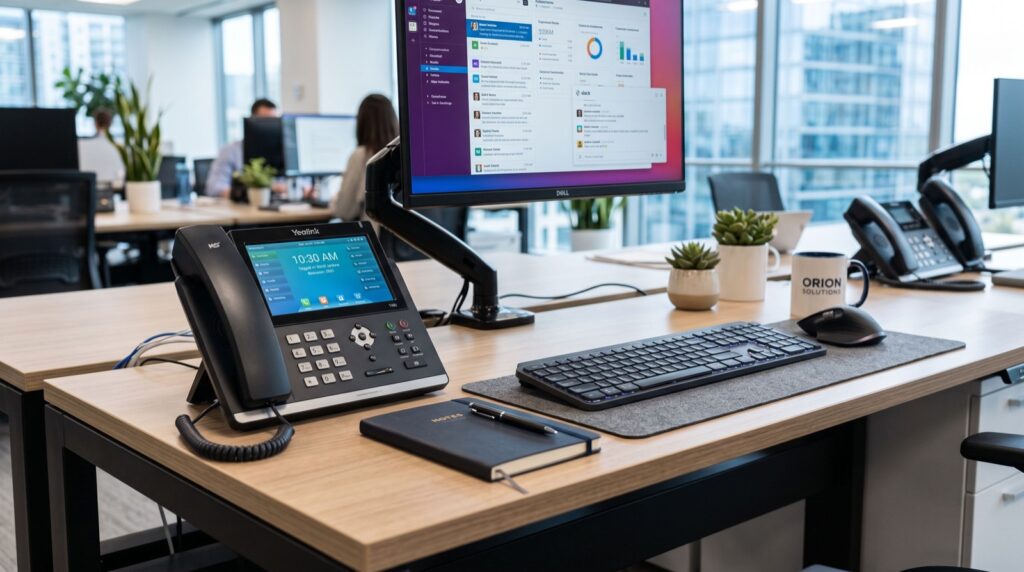
There is a quiet tension inside every growing company’s phone budget. Spend too much on flashy handsets and money vanishes on features nobody touches; spend too little and staff fight with laggy, feature-starved phones every day. The winning strategy in 2026 is smarter: build a tiered VoIP fleet where each desk gets exactly the phone it needs, from a compact entry unit to a flagship video device.
Why One Phone Model Never Fits a Whole Office
Offices are made of different jobs, and each job talks on the phone differently. A store-room extension used twice a day has nothing in common with a sales rep on calls for six hours straight. Forcing them onto identical handsets wastes money at one end and starves productivity at the other.
A tiered approach fixes this. You place capable, affordable phones where usage is light and reserve premium video devices for the people and rooms that truly benefit. The result is a system that feels generous everywhere without inflating the invoice.
The Entry Tier: Small, Reliable, Everywhere
Every office needs dependable phones in low-traffic spots such as storerooms, kitchens, lifts, and spare desks. These should be compact, tough, and cheap enough to deploy widely.
A device like the Fanvil H2U fits this role neatly, delivering clear SIP calling in a small footprint that suits tight spaces and high-deployment counts without draining the budget.
The Flagship Tier: Video and Collaboration
At the other end sit the leaders, receptionists, and meeting rooms that carry your brand on every call. Here, a large touchscreen and HD video pay for themselves in professionalism and time saved.
The Fanvil V67 Flagship Smart Video Phone anchors this tier, blending Android flexibility, apps, and smooth video into one polished desk device that turns routine calls into face-to-face conversations.
How Do You Map Phones to Every Desk?
Building a tiered fleet is easier with a simple planning table. Walk your floor, count the roles, and assign a tier to each before you order anything.
| Tier | Where It Goes | Core Strength | Rough Ratio |
|---|---|---|---|
| Entry compact | Storerooms, common areas | Low cost, small size | ~40% of desks |
| Standard business | Sales, support, admin | Multi-line, BLF keys | ~45% of desks |
| Flagship video | Execs, reception, meeting rooms | Touchscreen, HD video | ~15% of desks |
The Shared Foundation: SIP and Your PBX
The beauty of a tiered fleet is that every phone, cheap or premium, speaks the same language. They all register to one IP-PBX using SIP, the open protocol standardised by the IETF as RFC 3261.
This means a single system manages entry and flagship phones side by side. You get unified extensions, one voicemail system, one dial plan, and one place to update settings for the whole company.
A Practical Rollout Tip
Deploy in waves, not all at once. Start with one department, confirm call quality and provisioning templates work, then repeat the proven setup across the rest of the building. This staged method catches problems early and keeps the wider office running while you migrate.
Getting the Most From a Tiered Investment
A tiered fleet only pays off when the supporting details are handled well. Keep these priorities in view during planning.
- Standard provisioning: use auto-config templates so any tier deploys in minutes.
- PoE everywhere: power all tiers from one network switch for tidy, simple wiring.
- Consistent features: keep voicemail, transfer, and paging identical across tiers so staff never relearn.
- Room to grow: leave spare PBX licences and switch ports for the next hires.
- Security by default: enable TLS and SRTP on every device, not just the expensive ones.
Coordinating all of this is far smoother with reliable local experts who can design the tiers, configure the PBX, and test each wave before the old lines are switched off.
The Payoff of Getting the Mix Right
A well-tiered VoIP fleet routinely saves 20 to 30 percent versus equipping every desk identically, while actually raising satisfaction because the people who need power get it. Money moves from underused features to the places that generate revenue and impressions.
Just as importantly, a unified SIP system means adding a new employee is a five-minute software task in 2026, no matter which tier of phone lands on their desk.
Standardising Features Across Every Tier
A tiered fleet only feels seamless when the experience is consistent. Staff should not have to relearn how to transfer a call just because they moved from a compact phone to a flagship one. Consistency is what makes a mixed fleet feel like a single system.
Achieve this by defining company-wide feature codes and provisioning them centrally. The code to park a call, pick up a colleague’s ringing line, or reach voicemail should be identical on every device, from the storeroom to the boardroom.
Directory access is another unifier. When every phone pulls from the same central contact list, anyone can find any colleague or client without memorising extensions. This shared foundation is what separates a thoughtfully designed fleet from a random pile of handsets.
Even ringtones and branding can be standardised through provisioning templates, so the whole office sounds and behaves as one. These touches cost nothing beyond a little planning, yet they dramatically reduce support tickets and training time in 2026.
Managing the Fleet From One Dashboard
The operational payoff of a unified SIP system is central management. Firmware updates, security patches, and new feature rollouts happen from one console, pushed to every tier at once. There is no walking desk to desk with a USB stick.
This also strengthens security. When a vulnerability is disclosed, you patch the entire fleet in minutes rather than hoping each user updates their own device. Central control turns a diverse fleet into a manageable, defensible asset.
When to Add a Second Location
Growing businesses often open a second branch, and a tiered SIP fleet handles this beautifully. Because all phones register to the same PBX or a linked cloud service, a new office simply becomes more extensions on the existing dial plan.
Staff at both sites call each other by extension for free, share one auto-attendant, and present a single professional face to customers. Replicating your proven tier template at the new site means the second office is up and running in a day, not a month.
Frequently Asked Questions
Can entry and flagship phones share one phone system?
Absolutely. Because all of them use the open SIP standard, compact and flagship handsets register to the same IP-PBX and share extensions, voicemail, and dial rules seamlessly.
How many premium video phones does an office really need?
Usually far fewer than owners expect. Reserving video handsets for executives, reception, and meeting rooms, roughly 10 to 15 percent of desks, captures most of the benefit at a fraction of the cost.
Is a compact IP phone powerful enough for real work?
For light-use locations, yes. A compact SIP phone delivers clear HD calling and core features; it simply omits the large screen and video that low-traffic desks do not need.
Does a tiered fleet complicate management?
Not when phones share provisioning and register to one PBX. You manage the whole mixed fleet from a single dashboard, so different tiers do not mean different systems.
Conclusion
The smartest office phone strategy in 2026 is not the cheapest or the flashiest, it is the tiered VoIP fleet that gives every desk exactly the right handset on one unified SIP system. Match compact phones to light-use spots and flagship video devices to the roles that matter, and your budget works harder everywhere. Ready to design a fleet that fits your team? Explore the full range of Fanvil IP phones and build a phone system as varied as your office.